July 30, 2025
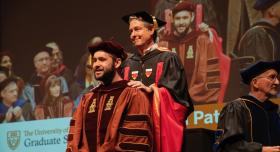
Dr. Nick Olson received the Margarida Jacome Dissertation Prize for his groundbreaking research on modeling and analyzing 6G wireless networks.
July 25, 2025
Professor Jeff Andrews received the 2024 CTTC Service Award at the 2025 IEEE Communication Theory Workshop for his outstanding leadership and long-term contributions to the CTTC, including founding its Steering Committee and significantly advancing the IEEE communication theory community.
July 24, 2025
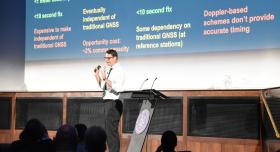
Professor Todd Humphreys received the prestigious Harold Spencer-Jones Gold Medal at the Royal Institute of Navigation’s (RIN) Annual General Meeting.
July 9, 2025
Dr. Daehyeok Kim has received a prestigious NSF CAREER Award from the Networking Technology and Systems (NeTS) program to support his research and educational efforts addressing key societal challenges.
July 9, 2025
Ph.D. student Wenyan Cong and others won the Best Paper Award at at the AI for Content Creation (AI4CC) Workshop, held at the Computer Vision and Pattern Recognition Conference 2025 (CVPR), one of the top conferences in computer vision. The award was for her work on “VideoLifter: Lifting Videos to 3D with Fast Hierarchical Stereo Alignment.”
June 11, 2025
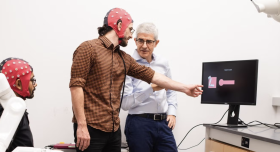
Did you know it’s possible to control a robotic arm or a wheelchair with just your thoughts, through a device called a brain-computer interface (BCI)? But for many users, learning to operate these systems is slow, difficult and, in some cases, unattainable. WNCG's CNBI Lab has discovered a novel way to accelerate this.
June 6, 2025
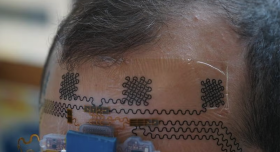
Published May 29 in Device, a new study co-authored by WNCG professor Nanshu Lu introduces a wireless forehead e-tattoo that decodes brainwaves to measure mental strain and may help track the mental workload of workers like air traffic controllers, surgeons, truck drivers and more.
May 29, 2025
WNCG & 6G@UT Graduates and Summer Internships
May 29, 2025
Dr. Kim has received this prestigious award for her innovative machine learning research
May 28, 2025
A multi-university team with heavy involvement from industry leaders is working to change that. The team, led by researchers from The University of Texas at Austin and 6G@UT's Dr. Sensen Li, plans to infuse artificial intelligence into the design process for RFICs to reduce the difficulty of making these important chips.